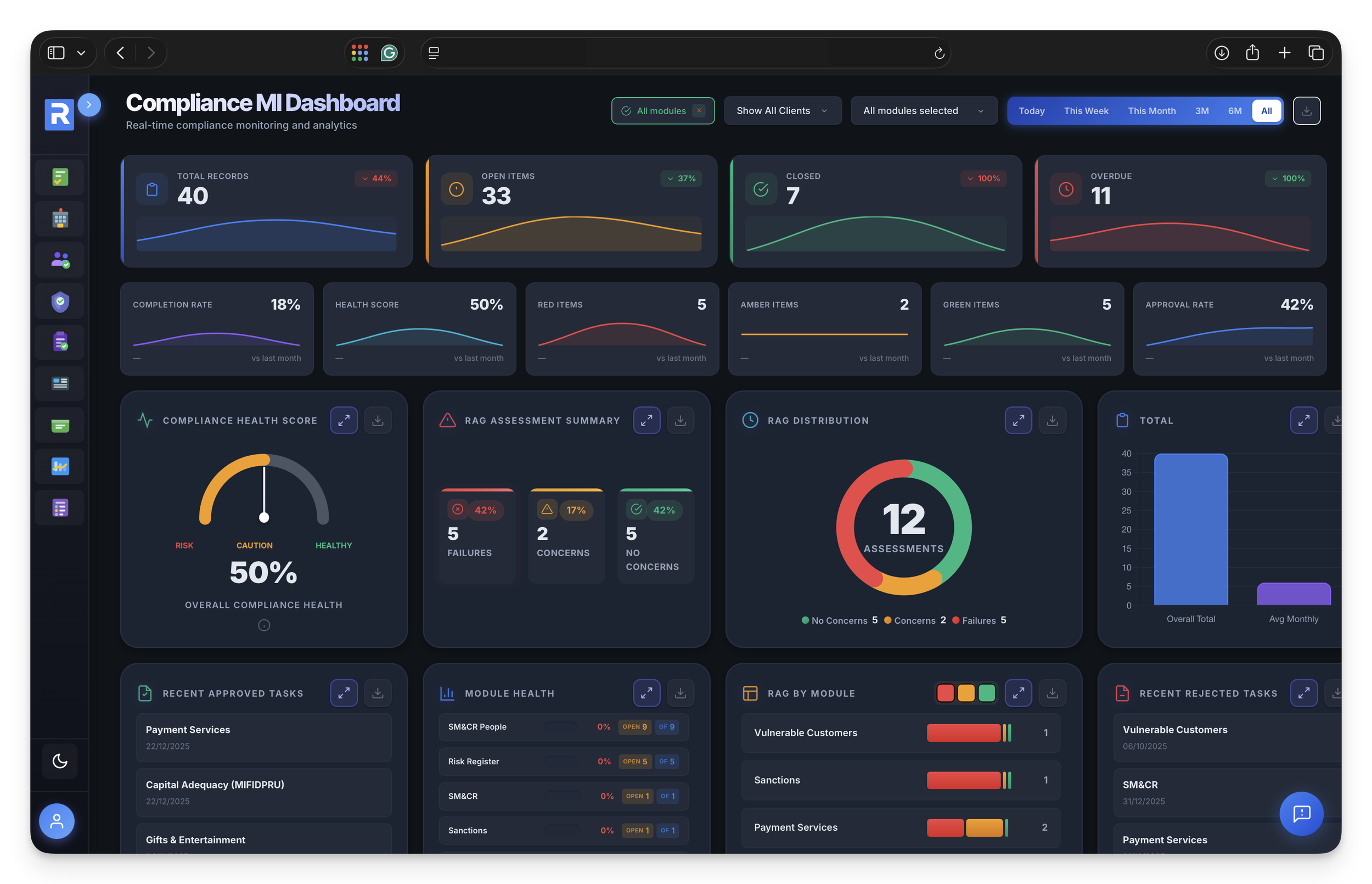
Surface the concentration risk before the Board does. Answer "who changed what, when?" in one click. RCSA cycles signed off with versioned audit snapshots. The Risk Committee Report Anna drafts from your live data — in 60 seconds, not five days.
Trusted by 250+ UK-regulated firms · Built by compliance professionals to make your life easier.
Book a ConsultationEnterprise GRC platforms charge £20–40k a year for the depth a Board challenge demands. Excel and PowerPoint cost less but won't evidence it under scrutiny — internal, regulatory or otherwise. There is a third option.
Your Excel register has a single "risk score" column. Inherent vs residual? A comment in column K. Appetite? A separate doc nobody reads. The FCA expects three scores per risk. Inherent, residual and appetite, with control effectiveness as the bridge.
Consultants rebuild your register from interviews once a year. You still own every risk. The artefact is constructed once then drifts out of date before Q2 even starts. SYSC 7.1 expects a live register, not a March snapshot.
Residual risk drifts over threshold mid-year. Nobody notices until the Q4 board pack. SYSC 7.1 expects appetite to be a live control signal, not an annual statement archived in a SharePoint folder.
Your controls register and your risk register are two separate spreadsheets. Which control mitigates which risk? Which is effective, partial, ineffective? The FCA wants one coherent view, not a Q&A session with the MLRO.
Spreadsheet register. PowerPoint heat map. Last year's appetite statement. The operating system below replaces all three — at the price of a software subscription, not an enterprise GRC contract.
Your regulatory perimeter shapes the language. The risk programme underneath is the same — and it's the one auditors, Boards and supervisors all recognise.
Anna's Risk Committee Report cited rule-by-rule to SYSC 7.1, SYSC 8, SYSC 15A, the CTP regime, PRIN 2A and MIFIDPRU 7. SM&CR ownership baked into every risk row. The audit trail SYSC 7.1.4R expects, captured automatically.
Material risk doesn't care about your regulator. The same three-score appetite framework auditors benchmark against. Concentration alerts the Board would otherwise spot first. The audit trail any internal-audit cycle is going to ask for.
Three things separate this from a spreadsheet — and from the enterprise GRC contract. The capabilities the CRO actually runs the firm from. Built for any firm with material risk to manage — including but not limited to FCA-regulated firms.
Most SMB risk tools are register CRUD and a heat map. Most enterprise GRC tools are the right depth at the wrong price. The capabilities below are the ones that change what the CRO can put in front of the Board — and the FCA — and they ship in a £500/month module.
Force-directed graph of every risk in your register. Causal links you define. Shared-vendor and shared-owner edges drawn automatically. Concentration alerts fire when 3+ risks share a single point of failure. The single biggest demo wow factor — and the visualisation enterprise GRC charges £20k a year for.
Quarterly Risk and Control Self-Assessment cycles built into the module. Owners attest, the register snapshot freezes at close, the PDF is immutable, the audit trail is the SYSC 7.1.4R evidence the FCA expects. The £8–20k consulting engagement, replaced.
Append-only field-level audit trail on every risk. Named user, timestamp, before/after diff, derived score changes. The question the FCA increasingly asks gets a one-click answer. Most enterprise GRC platforms charge £20k+ for this. Here it's standard.
Every artefact wired to the others — risks to controls to KRIs to incidents to actions to scenarios to vendors to causal network to attestations. Built for the Board challenge, the supervisor visit, and the £20–40k enterprise GRC contract you don't have to sign.
Inherent · residual · appetite — kept separate, never collapsed. 1–25 scale. Per-risk appetite override on the category default. Breach detection is automatic; "approaching" flagged at 80% threshold.
5×5 · Per-risk overrideOperational 17 · Regulatory 15 · Financial Crime 15 · Technology 12 · Conduct 12 · Reputational 10 · Compliance 10 · Strategic 9. Every template carries a regulator citation, suggested ratings, and 1–3 suggested controls. No cold-start.
8 categories · CitedDaily · weekly · monthly · quarterly · annually frequencies. Within / Warning / Breach status. Trend captured. Breaches drive escalation actions cited in the Anna report.
5 frequencies · 3 statesForce-directed D3 graph. Causal · shared-vendor · shared-owner edges. Concentration alerts at 3+ risks per SPOF. Board-pack PDF export at 96vw × 92vh.
3 edge types · Auto-alerts12 vendor categories. Critical / High / Medium / Low criticality. IBS & CTP designation flags. Exit plan status. Concentration analysis. The SYSC 8 / CTP regime evidence pack — already aligned to 2025 rules.
SYSC 8 · CTP regimeEvery change to every risk — logged with named user, timestamp, before/after diff. 100 entries per risk in JotForm; localStorage overflow to 1,000. Recently Changed dashboard tile surfaces 7-day activity.
SYSC 7.1.4R · Append-only4 campaign types · 3-step creation wizard · scope by all / category / owner / manual · per-attestor confirm-or-rerate · close generates immutable PDF audit snapshot signed off by named owners. Cross-posts to Document Library.
SYSC 7.1.4R · PDF-lockedAnna drafts every section from your live risks, KRIs, incidents, third parties, causal network and attestation campaigns. Cited to SYSC 7.1, SYSC 8, SYSC 15A, CTP regime, PRIN 2A and MIFIDPRU 7. Per-section regenerate · edit in place · HTML or PDF export.
14 statute anchors · Live data70% risk-ops + 30% framework, with premium-signal penalties for concentration alerts, overdue DD on critical vendors, untested exit plans and overdue attestations. Transparent on the dashboard. Can't be gamed by managing one input alone.
Composite · AuditableTemplates cited to specific regulators. Statute anchors cited in Anna's report. The Critical Third Parties regime, already aligned. For FCA-regulated firms, the SYSC framework is here. For any other firm with material risk to manage, the same governance backbone applies.
From £500/month · No tier gate. No add-ons. No setup fee.
A 30-second read on the firm's risk posture, the magnitude-ranked breach list the Board opens with, the force-directed network graph, the third-party register, the RCSA campaign tracker, and the field-level audit trail — one module, one data layer.
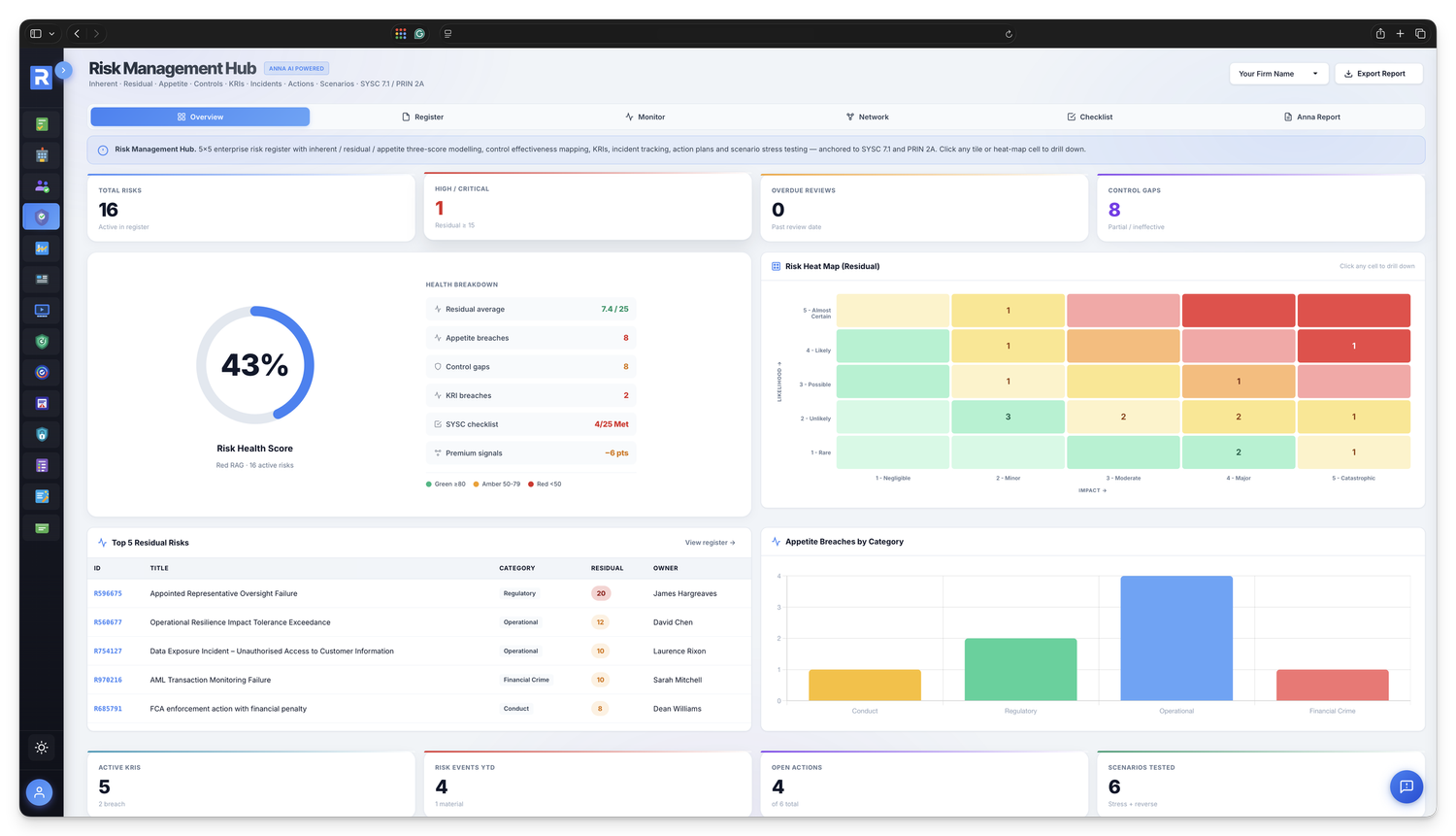
A 30-second read on the firm's risk posture: 4-tile KPI strip (Total Risks, High/Critical, Overdue Reviews, Control Gaps), live 5×5 residual heat map and a Breaches Over Appetite chart split by category. One screen — the board pack writes itself.
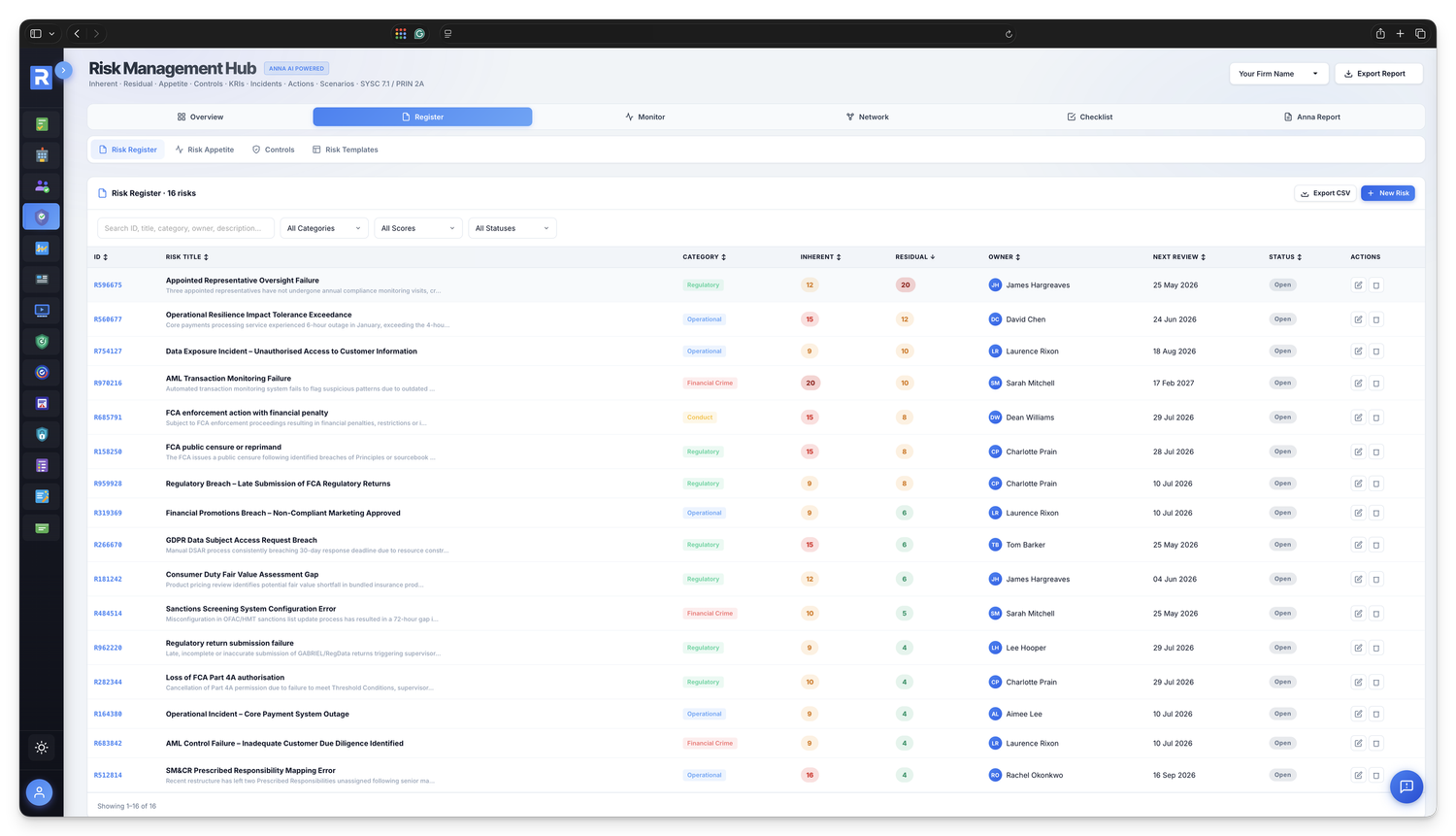
The 8-column register: ID · Title · Category · Inherent · Residual · Owner · Next Review · Actions. Colour-coded residual pills match the heat-map cell a risk lives in — and supports residual-exceeds-inherent, the realistic case where a control has degraded.
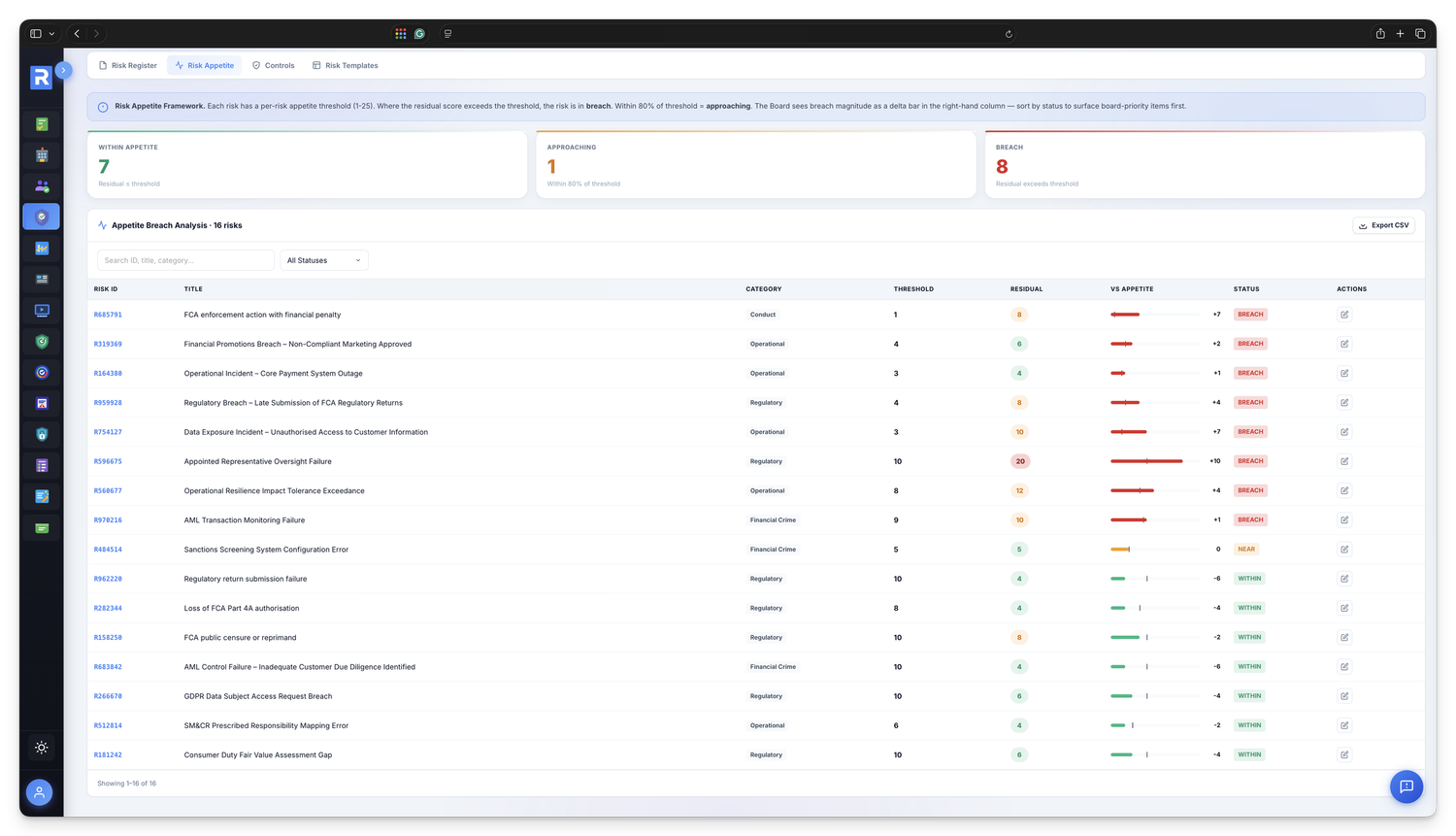
The Board tab. Per-risk appetite threshold, residual score, a horizontal VS APPETITE delta bar showing breach magnitude and a BREACH / APPROACHING / WITHIN status chip. The magnitude-ranked list the Board should open with.
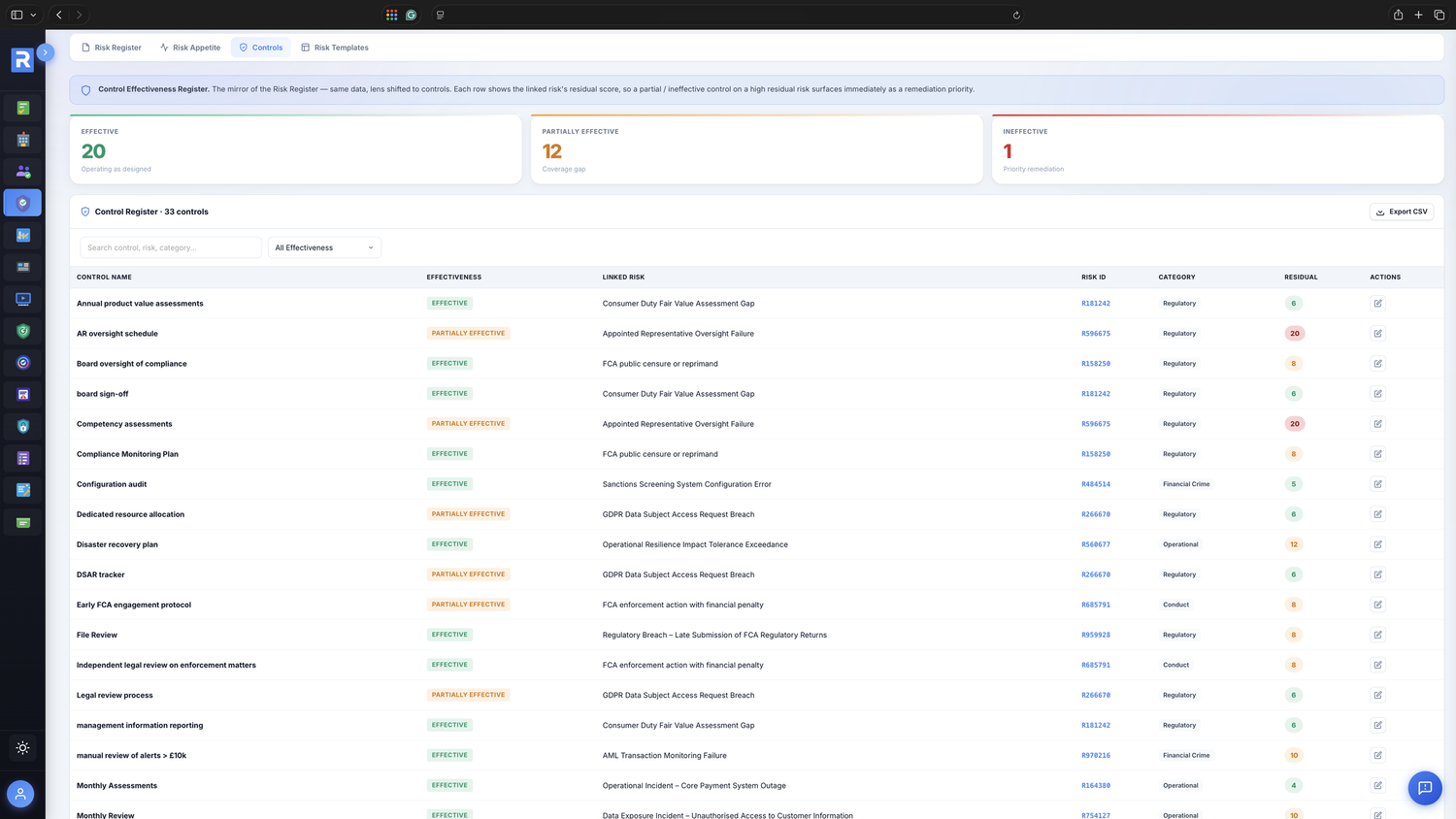
Score the controls behind every risk: design effectiveness, operating effectiveness, last-test date and a residual override when controls have degraded. Weak controls flag automatically — and roll into the Risk Committee Report from the same data.
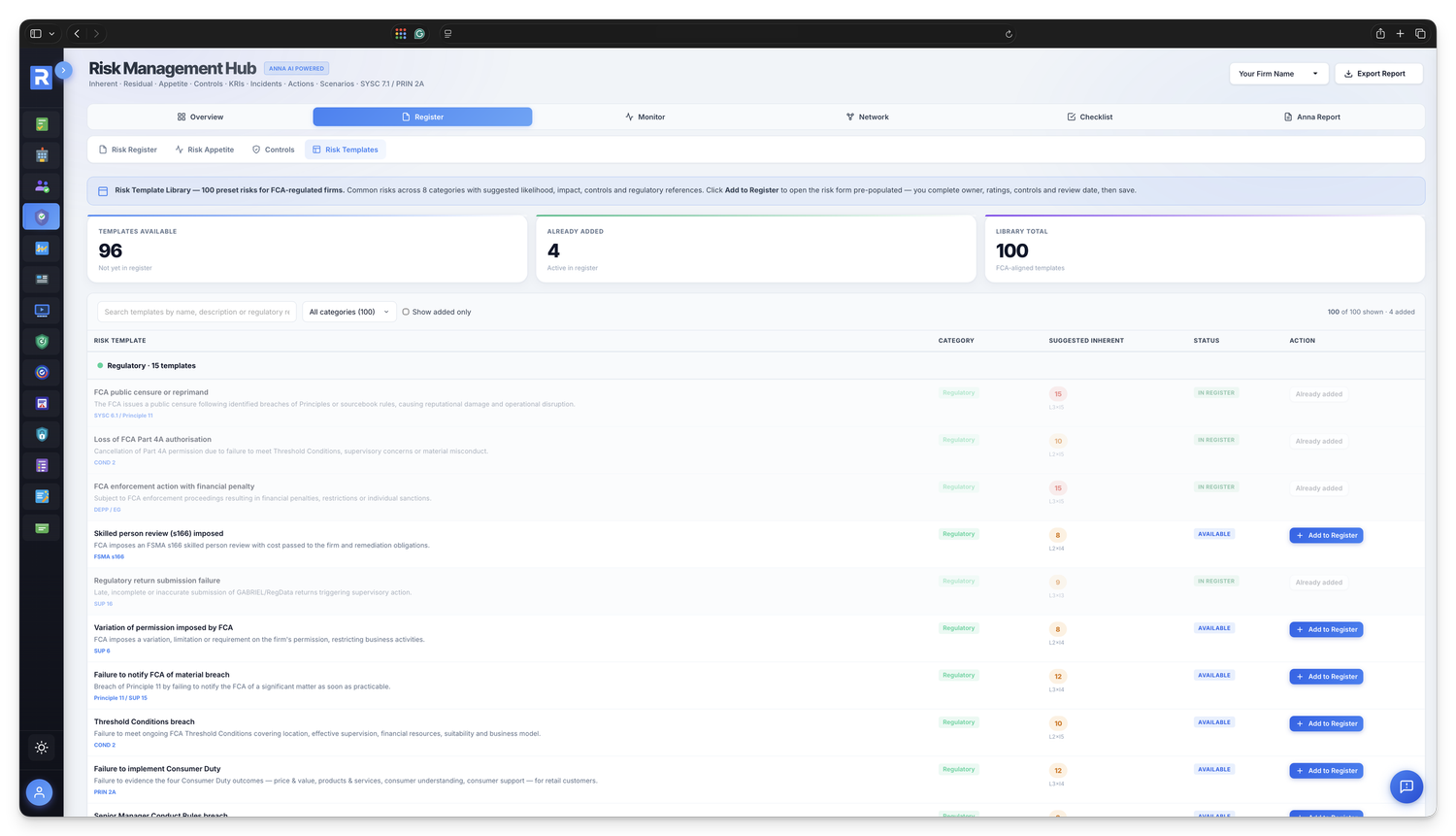
Common Risk Templates pre-built for FCA-regulated firms: cyber, third-party, regulatory change, conduct, financial crime, op resilience, prudential. Add to your register in one click — fully editable, fully attributed.
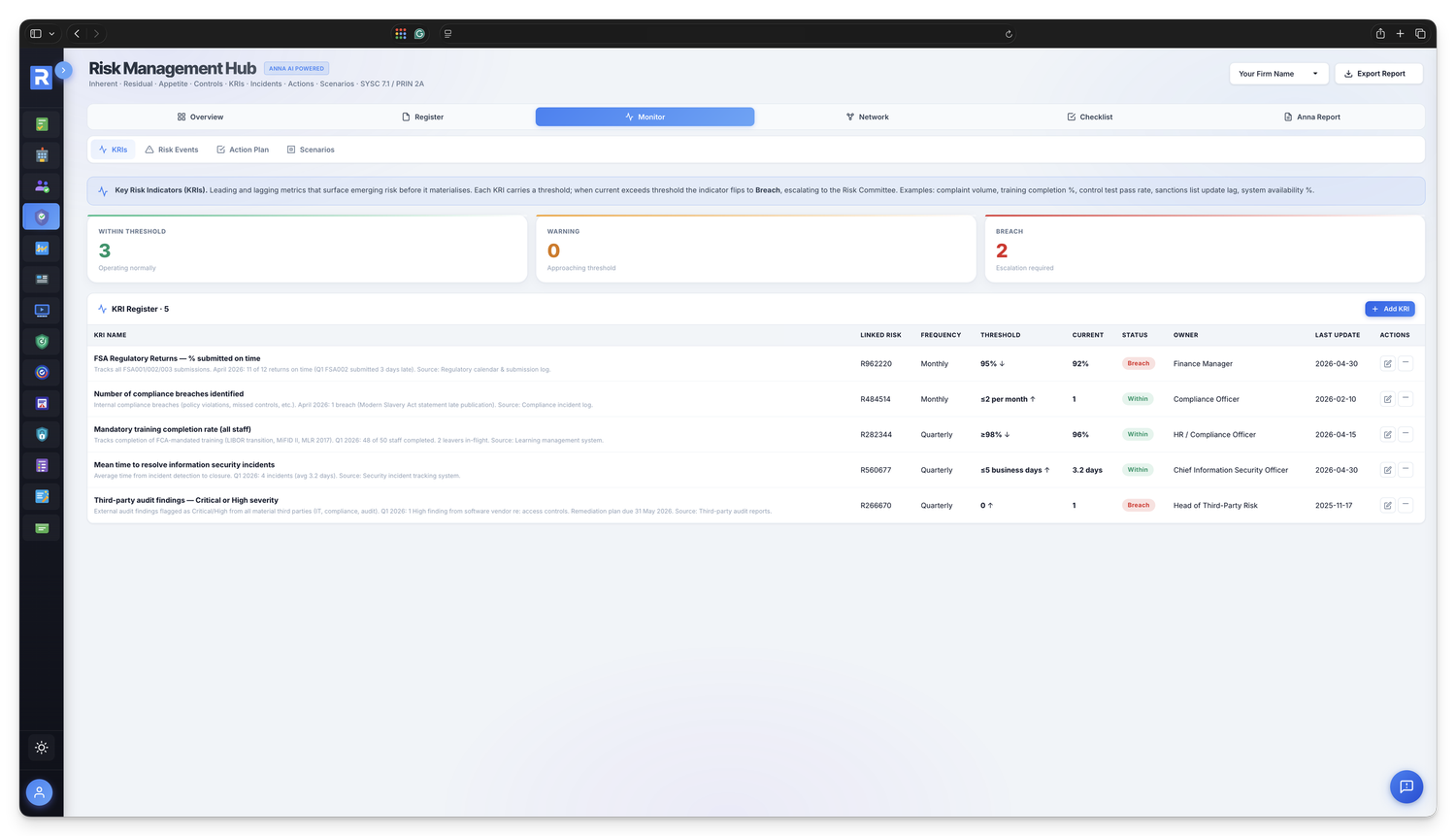
Key Risk Indicators tracked over time. Threshold breach alerts, trend lines, traffic-light status — every KRI tied to a risk in the register and a named owner who explains the move.
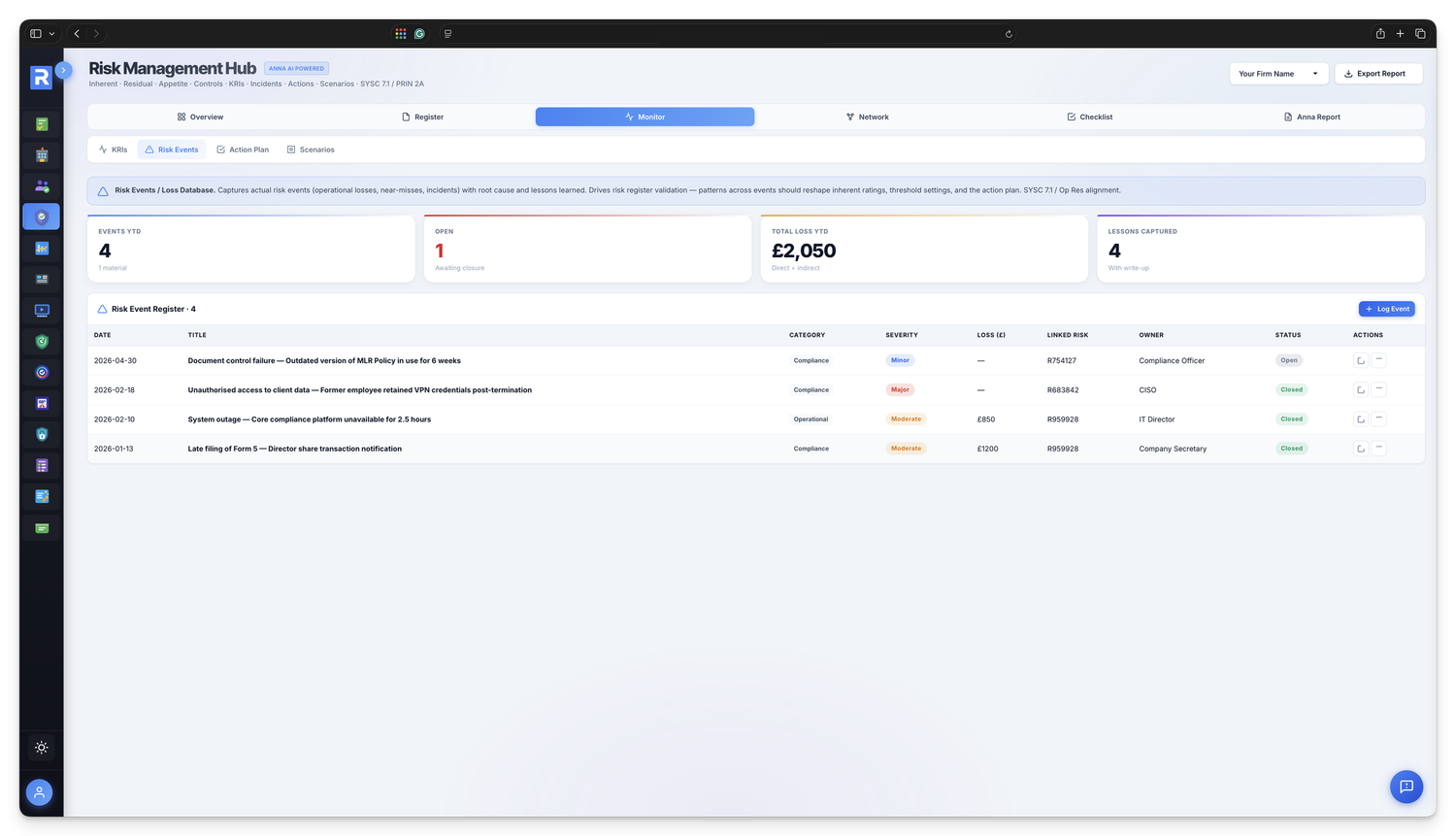
Every risk event logged: near-miss, loss event, breach, control failure. Root cause, financial impact, regulatory notification status — with the lessons-learned action that prevents the next one.
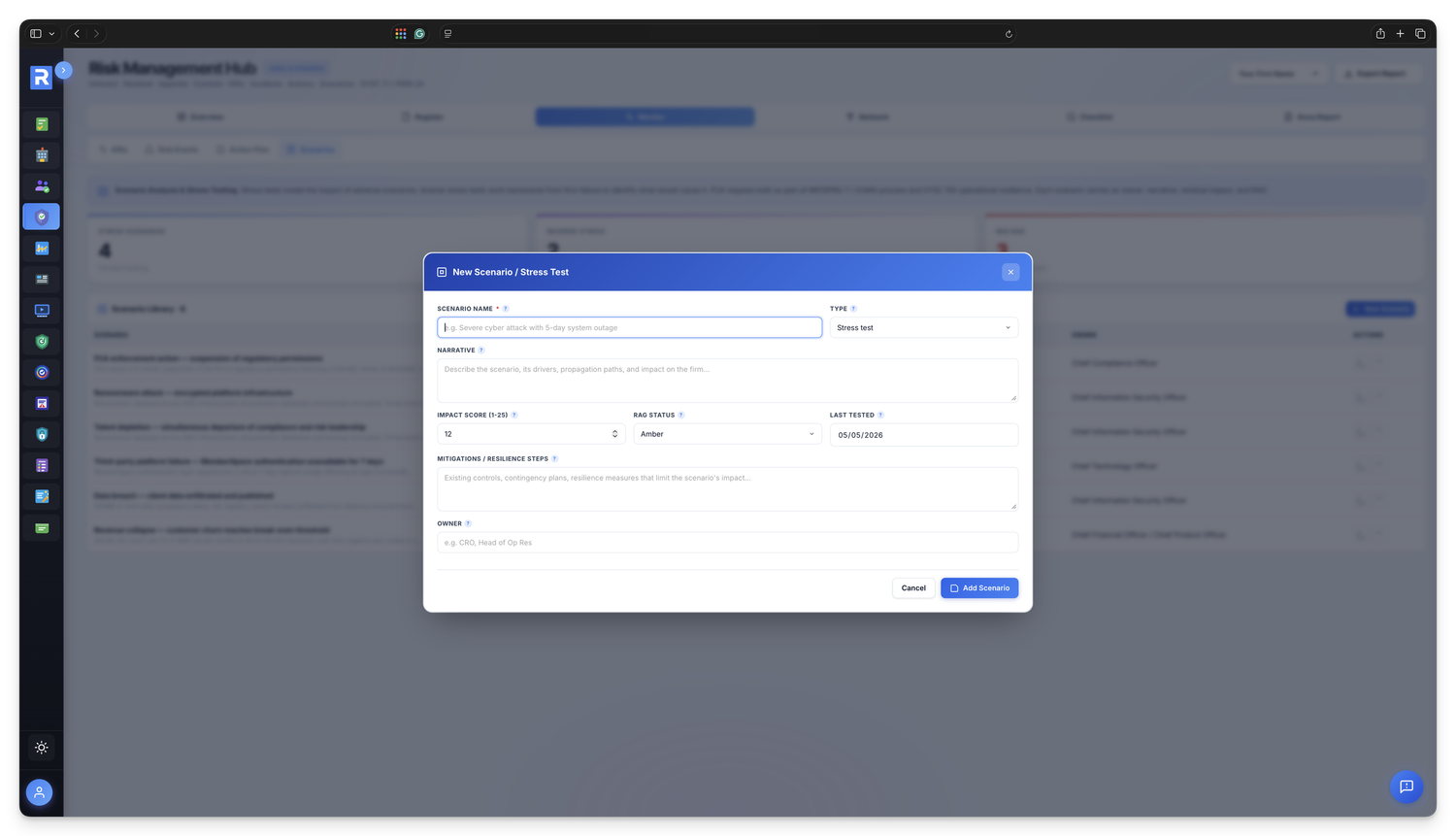
Scenario library and stress-test workbench. Run a scenario across the register, see which risks breach appetite, which controls fail and what the firm-wide impact looks like — without spreadsheet archaeology.
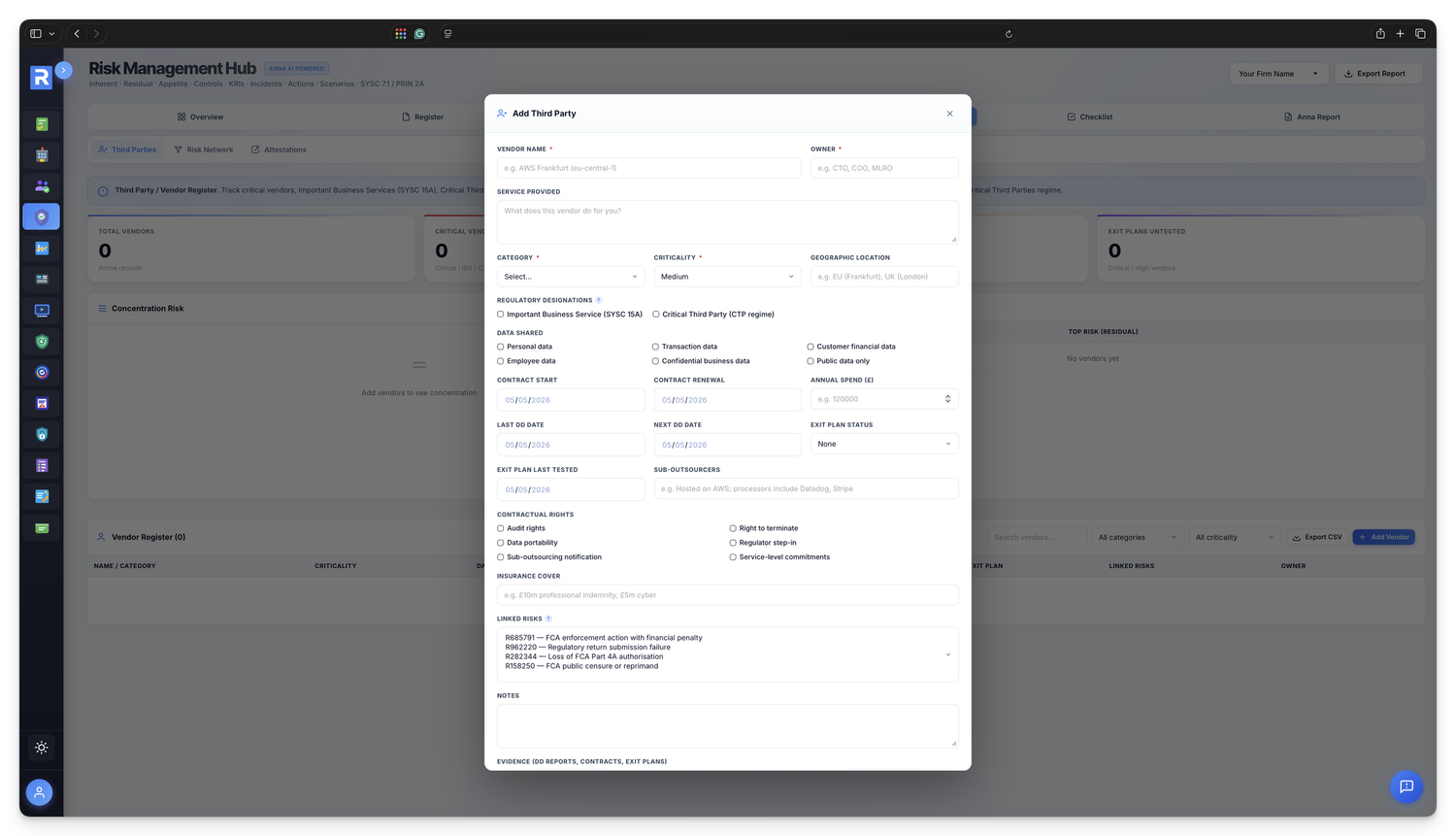
The Third-Party Register under SYSC 8 and the Critical Third Parties regime. Tier 1 / 2 / 3 classification, dependency mapping, exit plans, concentration alerts — every supplier the FCA expects to see, in one place.
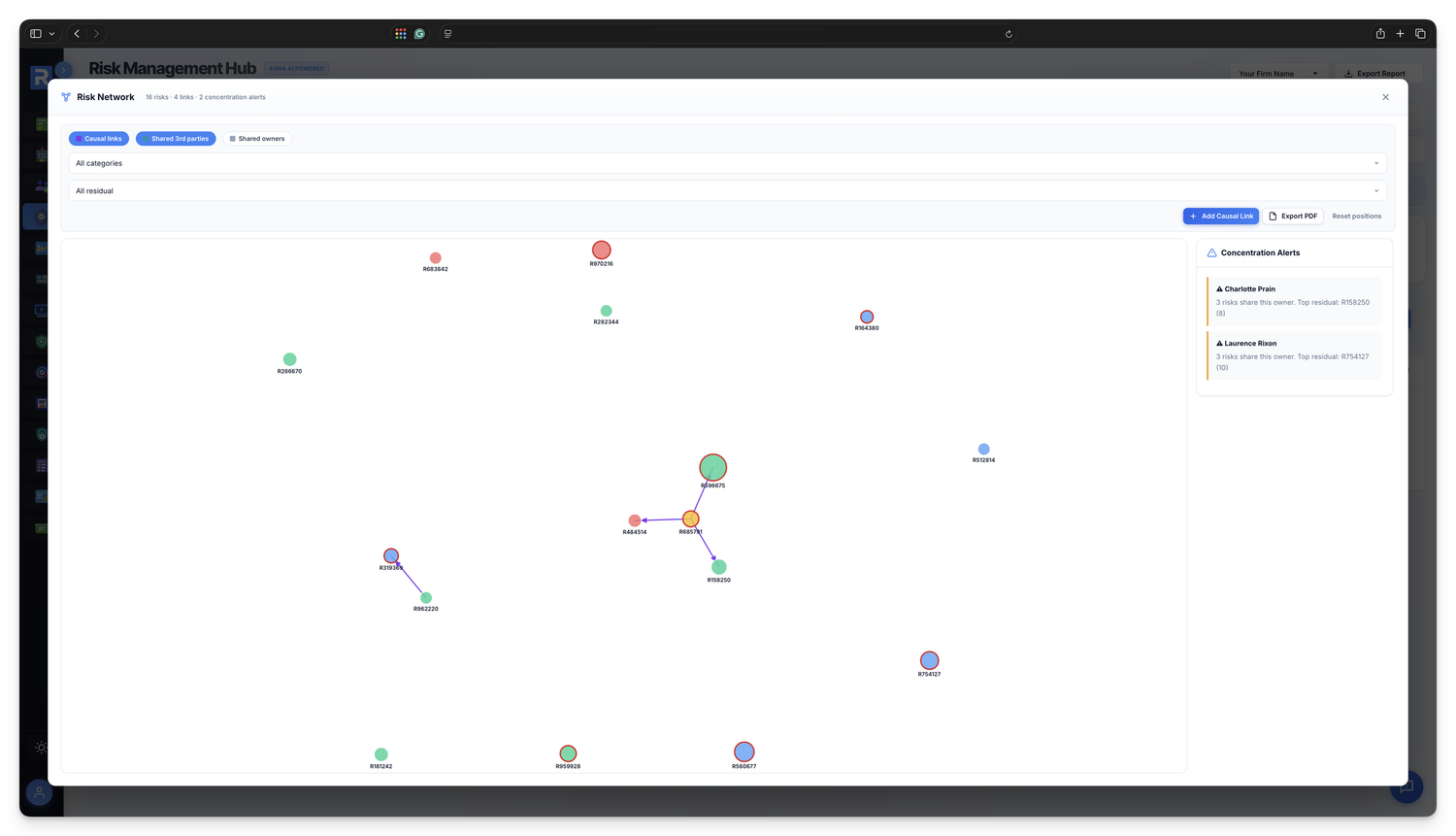
The force-directed Risk Network. Causal links between risks, shared third parties, shared owners — with concentration alerts that surface the systemic risks no register-only view can show.
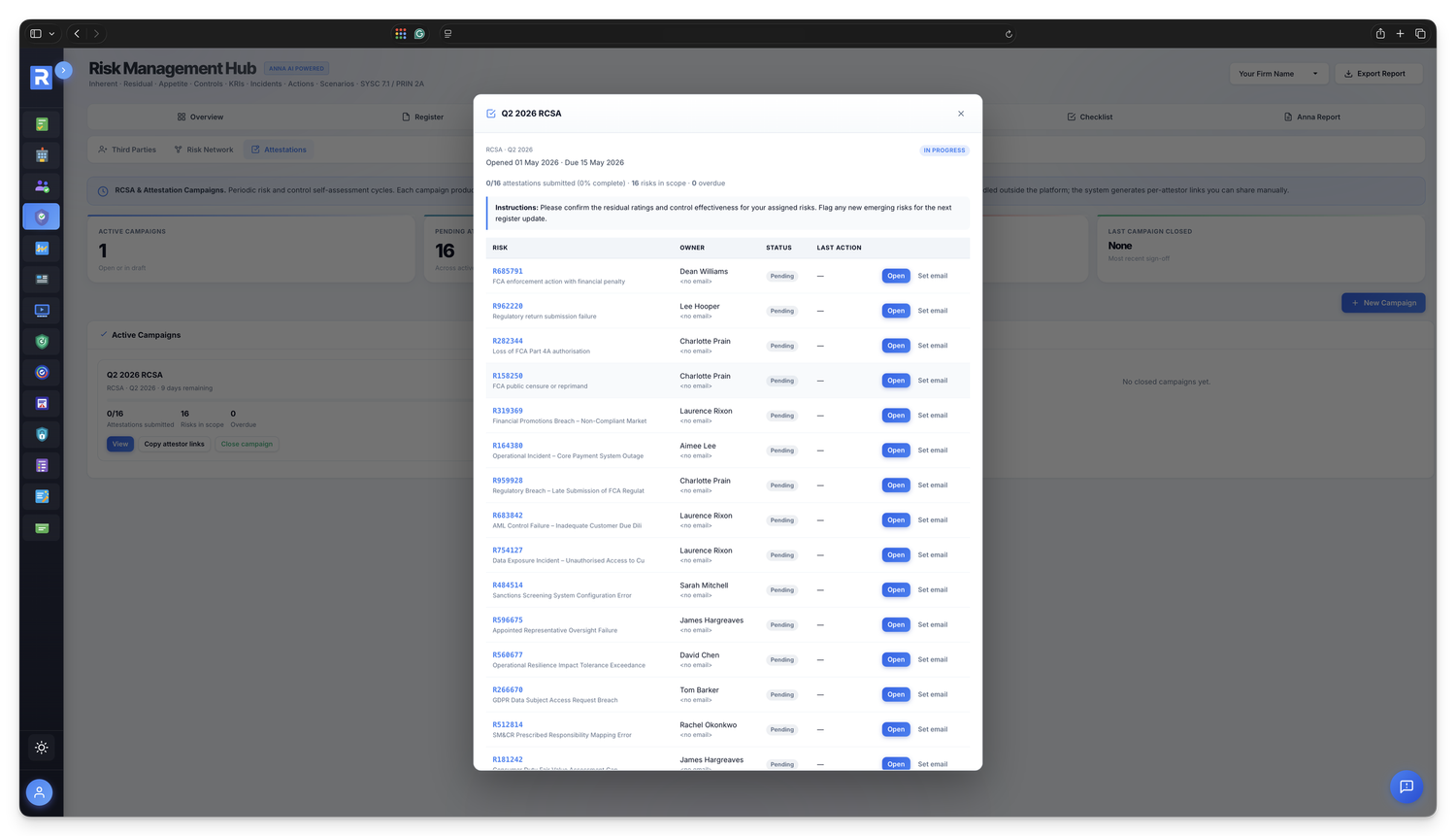
Risk Owner Attestation Campaigns. Quarterly RCSA cycles fired across the register, named-owner sign-off captured, signed audit snapshot at year-end — the SYSC 7.1.4R evidence the FCA expects, the ergonomics your team will actually live with.
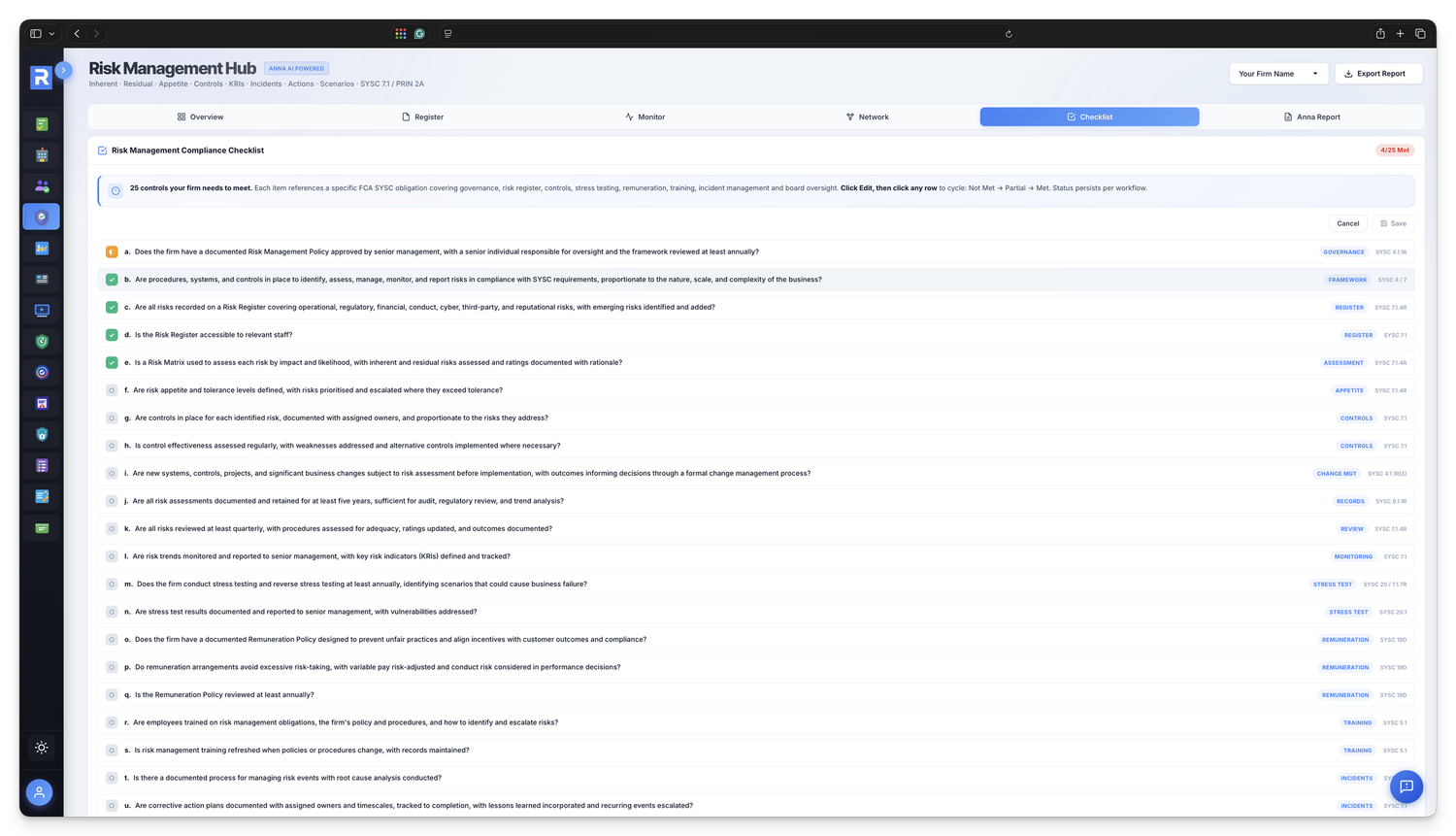
The SYSC 7 Compliance Checklist. Risk Management Function in place, SMF24 oversight, three-lines-of-defence integration, written risk strategy — every item attested by name and mapped to source rule.
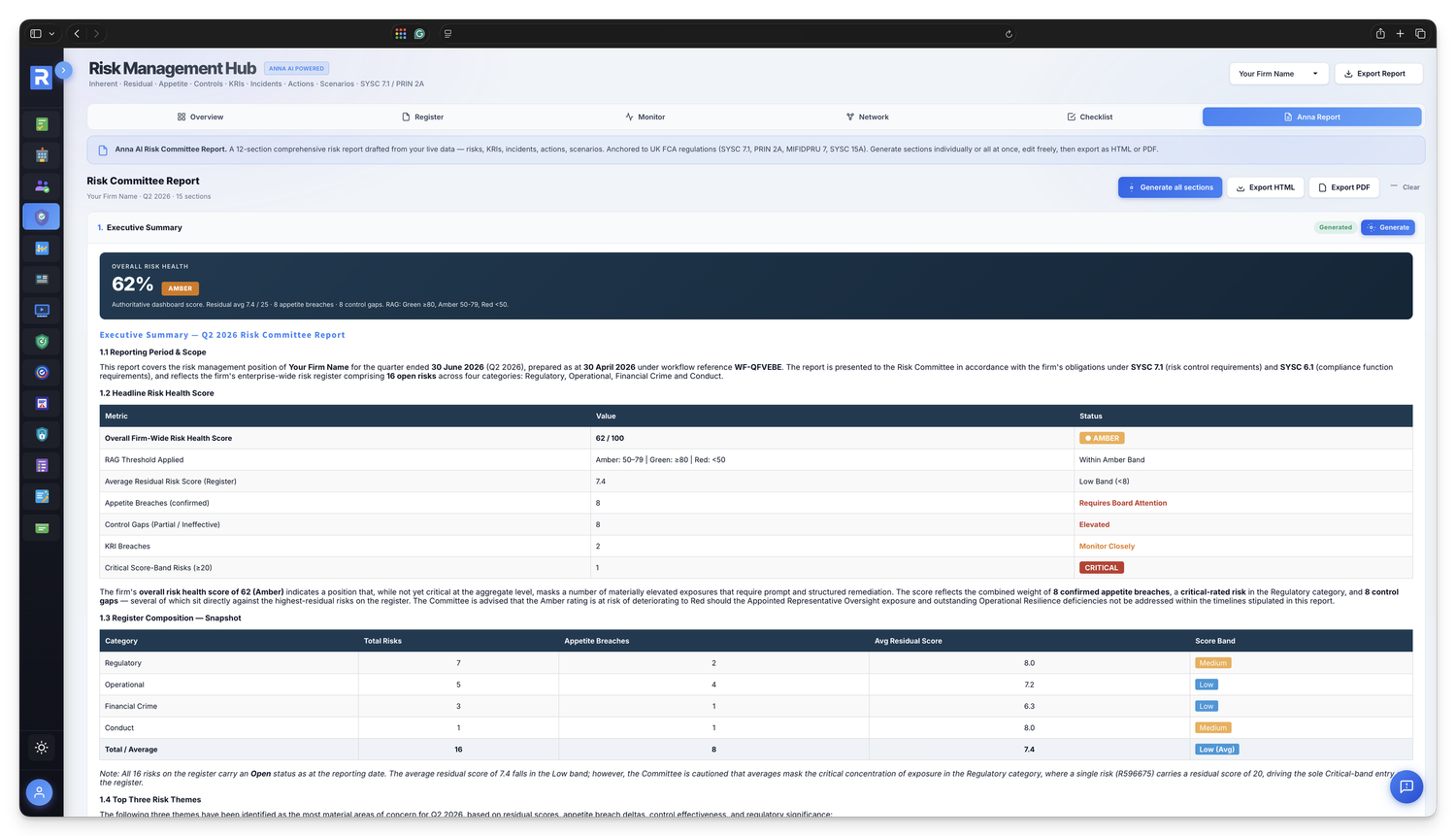
The 15-section Risk Committee Report drafted by Anna AI in 60 seconds. Pulls from your live register, KRIs, events, third parties and scenarios — formatted, evidenced and exportable. Three days of risk-team drafting collapsed to a click.
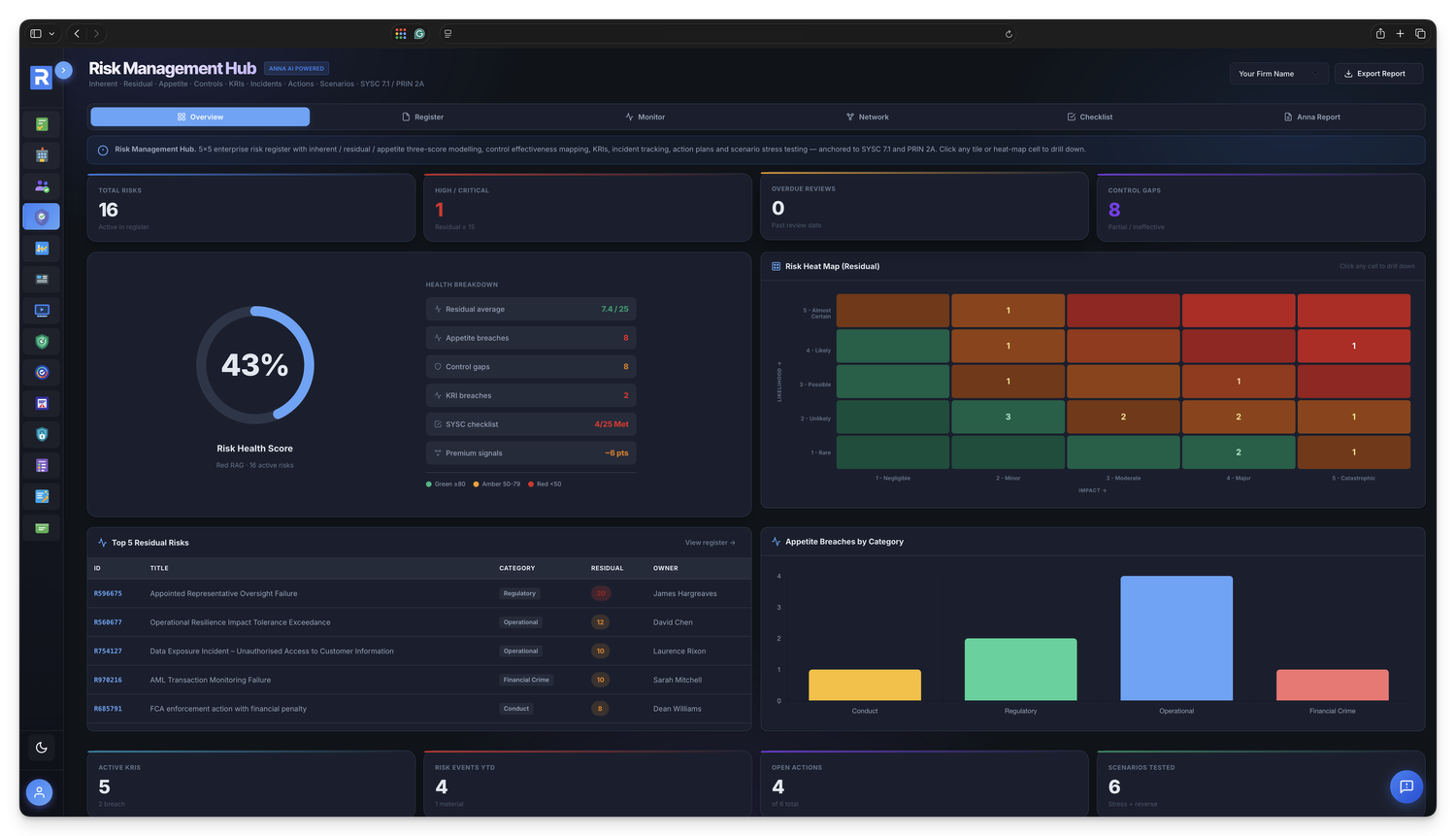
Long compliance days, gentler on the eyes. A full dark mode across every Risk Management screen — same WCAG-compliant contrast, same audit accuracy, just easier to live in.

Every risk on the register rolled into a single quarterly Board Risk Report. Inherent, residual and appetite scores side by side, a live 5x5 heat map, control effectiveness ratings, and appetite breach deltas. The document the Chair opens at the Board meeting. The document the FCA asks for in a SYSC 7 visit.
A quarterly report built from your live register, vendors, network and attestation campaigns. Each chapter maps to a SYSC, COSO ERM or CTP regime requirement, each table is source-matched to a record, and each heat-map cell reconciles to the underlying Inherent x Impact product.
Every appetite breach raised by a non-exec or Board member is logged against the risk record, with challenger, date raised, response due and status. The Board pack does not leave the room without each one tracked.
| Challenger | Risk / Question | Raised | Status |
|---|---|---|---|
|
Priya Natarajan
Independent NED · Risk Committee Chair
|
R131598 Conduct Risk Audit Failed: residual is +14 over appetite. Why has the CRO not requested an interim mitigation plan ahead of Q2? | Mar 18, 2026 | Attention |
|
Declan Okonkwo
SMF9 · Chair of the Board
|
R754127 Data Exposure: residual (10) exceeds inherent (9). Control has degraded. What has changed since the January RCSA? | Mar 21, 2026 | Open |
|
Yasmin El-Sayed
SMF1 · CEO
|
Technology category defaulting to threshold 6. Is this still appropriate after the June cloud migration, or should appetite be recalibrated? | Mar 22, 2026 | Resolved |
|
Marcus Vermeulen
INED · Audit Committee
|
R683842 AML control marked PARTIAL with residual green: what conditions would push residual amber before coverage expands? | Mar 24, 2026 | Open |
|
Hana Bergstrom
SMF4 · Chief Risk Officer
|
Proposal to split Operational into Cyber and Business-Continuity sub-categories for Q2 reporting, per FCA cyber resilience guidance. | Mar 26, 2026 | Resolved |
The Board Risk Report is not signed by a committee. It is signed by three named individuals, each accountable under SM&CR for a distinct part of the risk governance loop, with a time-stamped audit trail the FCA can walk through line by line.
Anna sits alongside the register, not on top of it. Ask her any risk-management question — she answers, cited to the standards your auditors recognise. Click Generate and she drafts the 15-section Risk Committee Report from your live data in 60 seconds. Two jobs, one assistant, zero invented content.
Two distinct jobs. First, Anna answers any risk-management question your team throws at her — appetite breaches, concentration alerts, control effectiveness, scenario design — cited to ISO 31000, internal-audit standards, and (for FCA-regulated firms) the relevant SYSC, MIFIDPRU and CTP-regime references. Second, she drafts the 15-section Risk Committee Report from your firm’s live register, KRIs, incidents, third parties, causal network and attestation campaigns. No invented vendors, no invented alerts, no LLM arithmetic.
“Which of our open risks breach appetite, and what's the concentration story?” “Where are our highest-residual risks dependent on a single critical vendor?” “What scenario should we run for next quarter's stress test?” Anna answers from your live register, the concentration-alert engine, and the standards your auditors recognise — in seconds, with citations.
Anna drafts the 15-section Risk Committee Report from your live data, surfaces concentration alerts before the Board sees them, and answers any risk-management question your team asks — cited to the standards your auditors recognise. See her draft your Risk Committee Report in a live demo.
From Heads of Risk to CROs, how firms are replacing the Excel register, the annual risk review and the PowerPoint heat map with a live register the Board actually opens.
Our risk register used to live in a single Excel file one person updated. The heat map got redrawn in PowerPoint for every quarterly board pack. Now we have a live 5×5, three scores per risk, and a VS Appetite delta bar in every row. Our CRO opens the Risk Appetite tab before the meeting, points at the +14 on Conduct, and the conversation starts in the right place. That alone changed how our Risk Committee runs.
We were paying a consultant every year to rebuild the risk register from interviews. It went stale by month three. The RegTechPRO module gives us the same shape (inherent, residual, appetite, controls) but it's ours, it's live, and the Board sees the real state not a March snapshot. SM&CR ownership on every row was the clincher. My SMF24 can't dodge a risk that has her name in the Owner column.
Everything you need to know about the 5×5 heat map, the three-score model, control mapping, and how Risk Management Hub sits inside SYSC 7.1 and SM&CR.